STINGER CAGE
Inventory management for bars and trade crews, counted out loud.
The inventory and event management system your bar already runs on — except Cage does bottles and pallets in the same count. Every count has a name on it, money doesn't move until you confirm, and a shortage shows up the moment you count short.
Live
Pulse, on a real house.
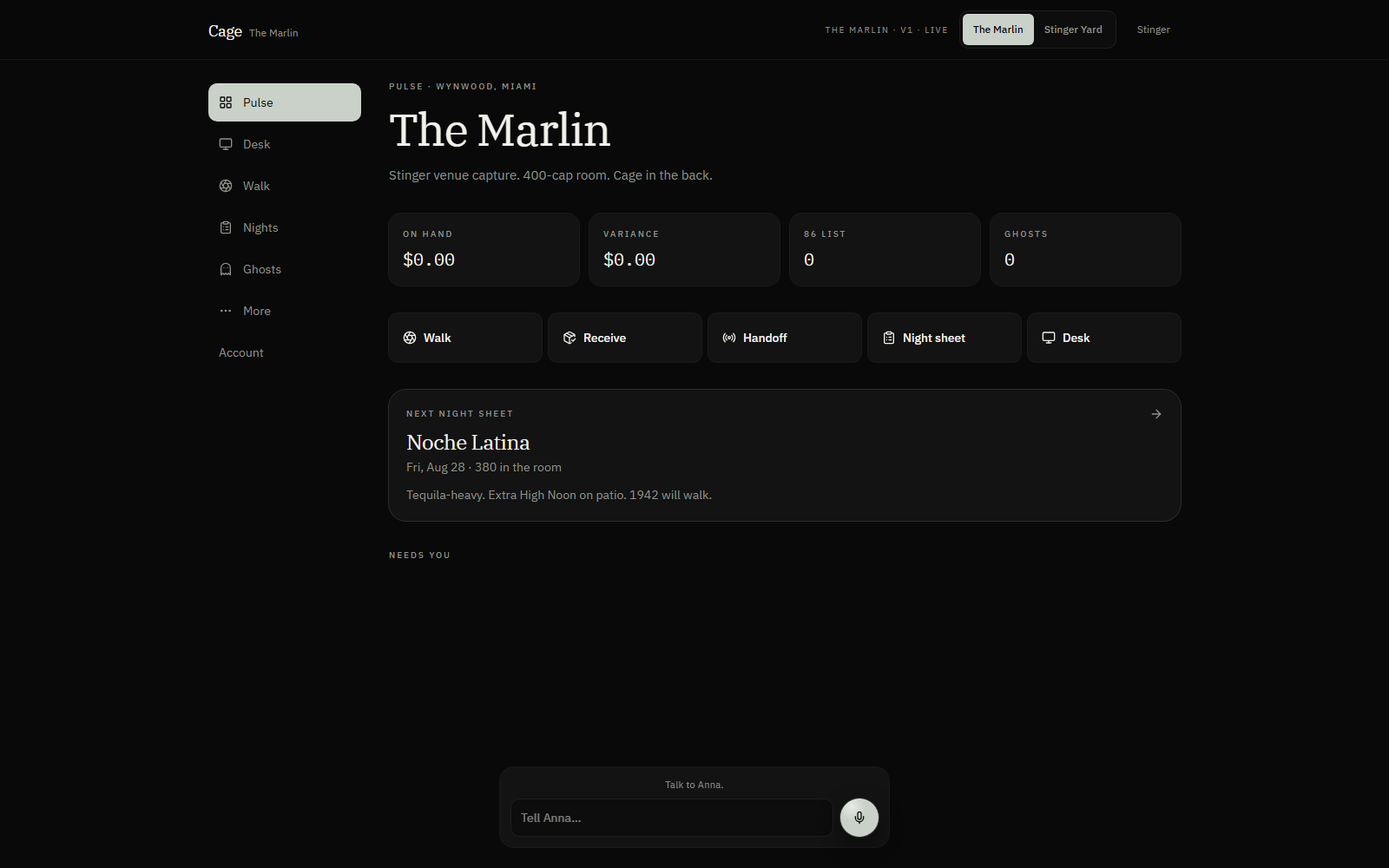
The Marlin — Wynwood, Miami · demo house, seeded, never the default on a real account
Ghosts
What the shelf denies.
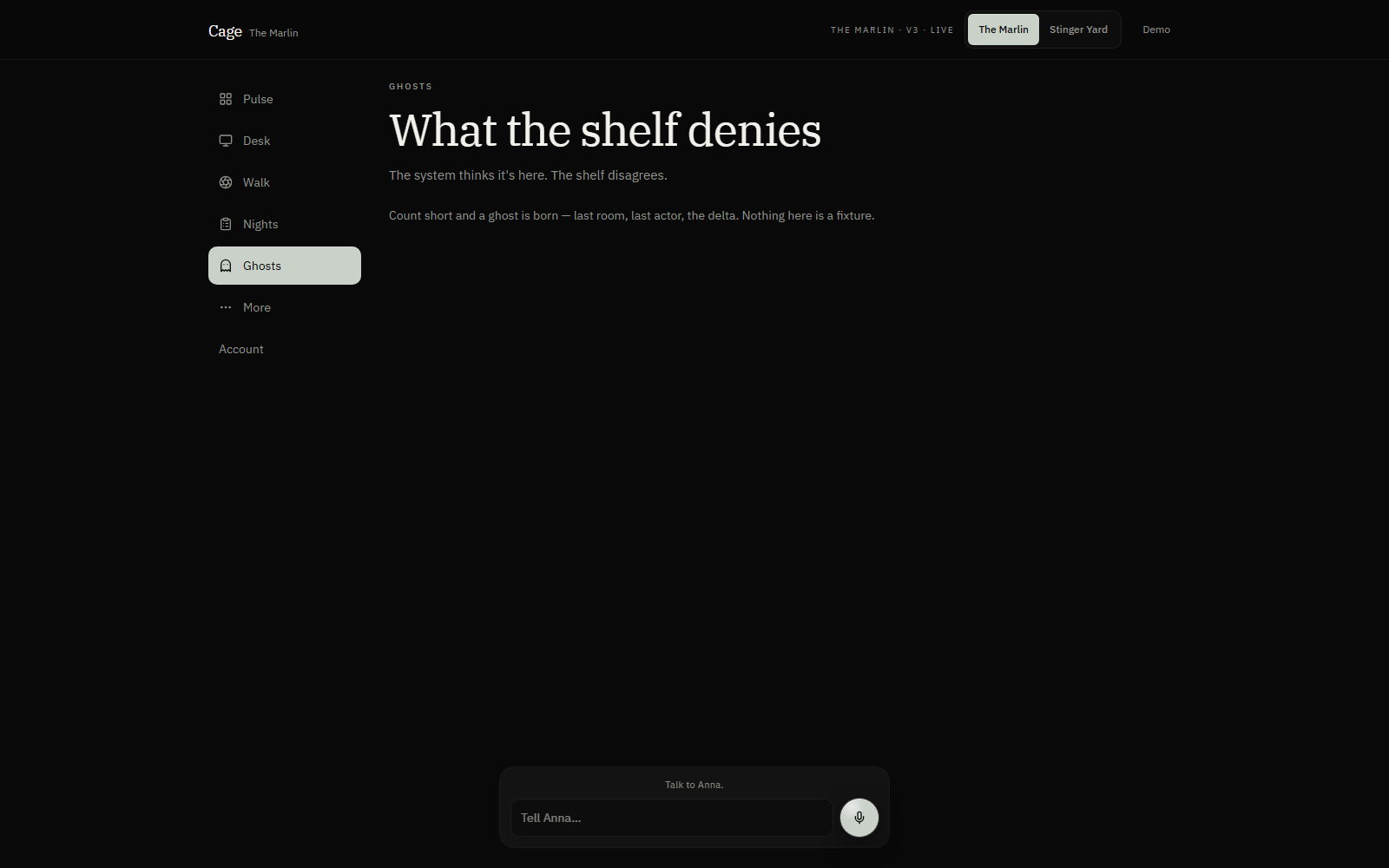
The Marlin — Wynwood, Miami · a short count births a Ghost, not a spreadsheet note
The problem
Hospitality inventory can't speak a crib. Trades inventory can't speak a bottle.
A bar's cage and a crew's crib, in one inventory system
A bar counts bottles on a rail. A crew counts parts in a crib or a yard. Cage tracks both — what's on hand, what moved, who last touched it — so you're not running two inventory systems.
Verbal first, camera when it matters
Talk it in — "Tito's four full, six tenths," "twelve trichlor pails." Point the phone with Lens when a shelf or a slip needs to be seen. If the camera isn't sure, it drops the read instead of guessing.
The van and the patio count too
The rail, the patio, the festival van, truck 12, a conex in the yard — each one is a real stock location you walk in the same order, not a leftover pile the system forgets.
Shrinkage
How does Cage track shrinkage instead of just reporting it?
Ghost Hunt
Every shortage keeps the last room it was seen in and the last person who counted it. It stays open, found, or written off — never just deleted.
Variance $ that actually moves
Pulse shows Variance $ as missing quantity times unit cost, and it moves the moment you count short — not as a static report you check later.
86 Pulse
What's dead hits the floor now, not at the next physical count.
Variance Timeline
Transfers, comps, waste, Ghosts — all on one timeline, all with named people attached.
Receiving & ordering
How does Cage prevent double-counting a delivery?
Photo Receive
Photograph the invoice, confirm the count. If the same slip gets scanned twice, stock doesn't get counted twice.
Pack Truth
A $0.29-per-unit price on a six-pack invoice is a lie until someone rewrites the pack size. Cage flags it instead of posting it to the books.
Suggested orders
Par gap plus sheet extras, rounded to pack, grouped by vendor. Purchase orders move draft to sent to partial to closed, and receiving against a PO cannot over-receive it.
Ninety-Second Handoff
Open the floor, close the cage, load out, lock the crib — exceptions only, so a shift change doesn't mean a full recount.
What's real vs. what's roadmap
Money doesn't move until you confirm — and the screen is honest about what isn't connected yet.
The confirm step does not bend
Money, receiving, and shift-change release only on a typed or tapped confirm. Annabelle can queue an action; she cannot release one. A stock-counter cannot pretend to be the manager, and cannot change pack size, cost, the books, or orders.
List math, labeled as list math
Until a POS contract exists, pour cost and cost-of-goods are computed from list price — and the screen says so. Cage does not fake a point-of-sale connection, and competitor pricing stays off the customer screen entirely.
Roadmap, called out as roadmap
POS and accounting-software integration are contract-gated, not faked. Native iOS/Android apps and a shared login with Command Center are staged next — money still needs a human confirm when they land; that rule does not get rebuilt weaker.
How it compares
Cage against BinWise, MarketMan, and Sortly.
Every one of these three is built for one vertical — bar, restaurant, or trade — not both. Cage's honest gaps: no POS integration yet (contract-gated, called out as roadmap) and no native mobile app yet, both of which the single-vertical players already have.
| Feature | Cage | BinWise | MarketMan | Sortly |
|---|---|---|---|---|
| One system for both bar/venue liquor inventory AND trade/yard parts inventory | Yes | no — bar/liquor only | no — restaurant/bar only | no — general/trade only, no bar-specific features |
| Voice-based stock counting | Yes | Unclear from public page | Unclear from public page | Unclear from public page |
| Photo-based invoice receiving that flags implausible pricing before it posts | Yes | Partial — invoice upload exists, no pricing-sanity check stated | yes — AI invoice scans | Unclear from public page |
| A shortage becomes a persistent, named record — open until resolved, not just a report line | Yes | Partial — variance report, no case-record described | Partial — variance shown as a metric, no case-record described | no — no shrinkage feature found |
| Point-of-sale integration for real-time cost data | Roadmap | yes — 50+ POS platforms via Avero | yes — Square, Toast, Lightspeed, Clover | No |
| Purchase-order workflow with over-receipt prevention | Yes | Partial — stages/prevention not detailed | Partial — stages/prevention not detailed | Partial — no draft state documented |
| Native iOS/Android app | Roadmap | Yes | Yes | Yes |
| Monthly cost beyond your plan | No | Not published — demo/quote only | $249/mo (Starter) | Free–$24/mo |
Competitor figures pulled from each vendor's own pricing/feature pages, 2026-09-03. Cage features drawn from what's live today per this page and the internal capability catalog.
Get started
Start empty, or walk The Marlin first.
Sign in and name your own house — a venue or a yard — and import your spreadsheet. Or load the Stinger demo to see a fully seeded venue and yard before you commit a single real count.
Related: send counted costs straight into Bound for the books, or see Cage inside the full Stinger platform.